Who Was Oskar Schindler, and How Many Jews Did He Save?
Oskar Schindler's life, the Brunnlitz list of 1,098 names, the 1,200 figure on his gravestone, and what separates the record from the 1993 film.
Oskar Schindler was a Sudeten German industrialist who took control of a bankrupt Krakow enamelware factory in 1939 and spent the next five years shielding its Jewish workers from deportation and death. He did it through bribery, forged paperwork and a wartime industry’s cover, not through one dramatic act, and the factory you can visit today is where most of that happened.
The factory is now a museum. You can visit on your own with a timed ticket bought directly from the museum (60 PLN; Mondays are free, with tickets sold at the door on the day), and it runs its own English-language tours from Tuesday to Sunday. If you want a guide, Tours with Ewa’s tour includes entry to the Factory and two further stops on the same ticket, the Eagle Pharmacy and Pomorska Street, usable within 7 days of your visit date. It runs 1.5 hours with a live guide, from $45 per person on the booking platform when we checked, rated 4.5 from 1,854 reviews.
How Schindler came to own the factory
Schindler was born in 1908 in Zwittau, then part of Austria-Hungary and later Czechoslovakia, to a Sudeten German family. He joined German military intelligence, the Abwehr, in 1936, and was arrested and briefly imprisoned by the Czechoslovak government for espionage in July 1938, before the Munich Agreement freed him that October. He applied to join the Nazi Party the following month. A year later, in November 1939, he was appointed trustee of Rekord, a bankrupt enamelware works at ul. Lipowa 4 that three Jewish entrepreneurs had founded in 1937. He leased the site in January 1940, later bought it outright partly with capital from Jewish investors, and renamed it Deutsche Emailwarenfabrik, making civilian pots and pans and, to keep his classification as an essential war industry, ammunition shell casings.
A factory, then a camp of its own
At its 1944 peak the factory employed around 1,750 workers, roughly 1,000 of them Jewish. Schindler had a forced-labour subcamp of the nearby Plaszow camp built on the factory grounds itself, so his resident workers had, by two independent accounts, scarce contact with camp guards and fared better than those left at Plaszow proper. As the Eastern Front advanced in autumn 1944, he moved the factory and its workforce to Brunnlitz, a village near his hometown in the Sudetenland, by then annexed to Germany and today in the Czech Republic, and set up a subcamp of Gross-Rosen concentration camp there.
How many people he saved, exactly
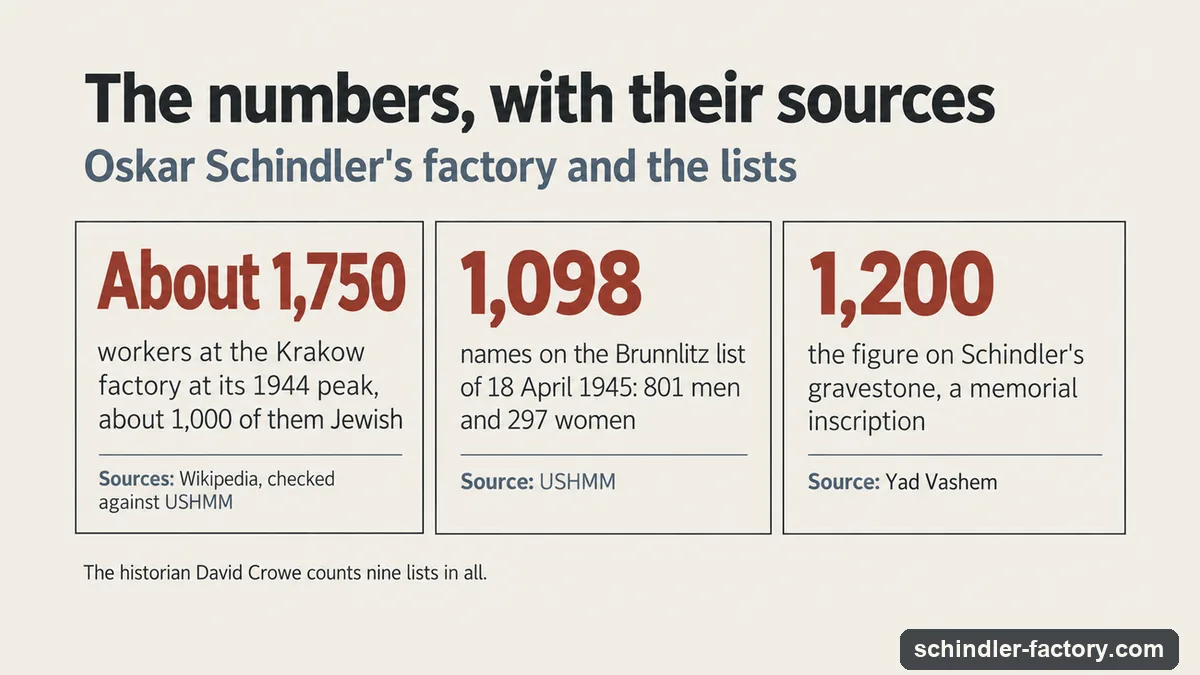
There was no single Schindler’s list. Historian David Crowe counts nine overlapping lists in total, four of them compiled by Marcel Goldberg, a member of the camp security police whom later historians describe as corrupt. The most precise surviving document is a Brunnlitz prisoner roll dated 18 April 1945, naming 1,098 people — 801 men and 297 women, combining those transferred from Plaszow with new arrivals. The commonly quoted figure of 1,200 is not from that document; it is the rounded number inscribed on Schindler’s own gravestone in Jerusalem, a memorial, not a headcount. Both numbers are real. They are simply not the same number, or the same kind of number, and a careful answer uses both with their source attached.
Emilie Schindler’s part in it
Oskar did not do this alone. In brutal conditions in January 1945, 120 male prisoners evacuated from a quarry subcamp of Auschwitz arrived at Brunnlitz in sealed wagons after a seven-day journey without food or water. Emilie Schindler stopped the camp’s SS commandant from sending the train back, had the men added to the factory’s protected workforce, and nursed the starving, frostbitten survivors herself. Oskar and Emilie were jointly named Righteous Among the Nations by Yad Vashem on 24 June 1993.
After the war
Schindler’s later life undercuts any tidy ending. He emigrated to Argentina with Emilie around 1949, failed at farming, went bankrupt in 1958, and left her there when he returned alone to Germany, where further ventures failed and he declared personal bankruptcy in 1963. He lived largely on donations from the people he had saved, made repeated visits to Israel, and died in Hildesheim, West Germany, in 1974, aged 66. At his own survivors’ initiative, he was buried in Jerusalem, in the Catholic cemetery on Mount Zion; he is often described as the only former Nazi Party member buried there. Emilie, left in Argentina to settle his debts, lived in hardship for decades before her death near Berlin in 2001.
The film, and where it differs
Steven Spielberg’s 1993 film Schindler’s List, based on Thomas Keneally’s 1982 novel Schindler’s Ark, is why most visitors know this story at all. It won seven Academy Awards, including Best Picture. Inside the museum, Schindler’s own office appears only near the end of the route — a late, small chapter in a much larger exhibition about Krakow under occupation, rather than the whole of it.
The exhibition covers this story in far more depth; what’s inside the museum describes the rooms themselves. The ghetto his workers were spared from is a short walk away, in Podgorze, not in Kazimierz — the Krakow ghetto covers it, and is it worth visiting weighs the whole site against what else is nearby. Every guided option is compared on the homepage.
Sources: USHMM, Yad Vashem, Wikipedia (cross-checked) and the Silent Heroes Memorial Centre; product details from the operator’s own listing. Checked October 2026.
Book a Guided Visit to Schindler's Factory
Tours with Ewa's combined Memory Trail ticket covers the Factory, the Eagle Pharmacy and Pomorska Street with a live guide, rated 4.5 from 1,854 reviews. Visitors who prefer no guide can buy directly from the museum and take its own English-language tour instead.
Check Availability